Navigating the Agentic AI Revolution: Building Internal Expertise for Sustainable Success
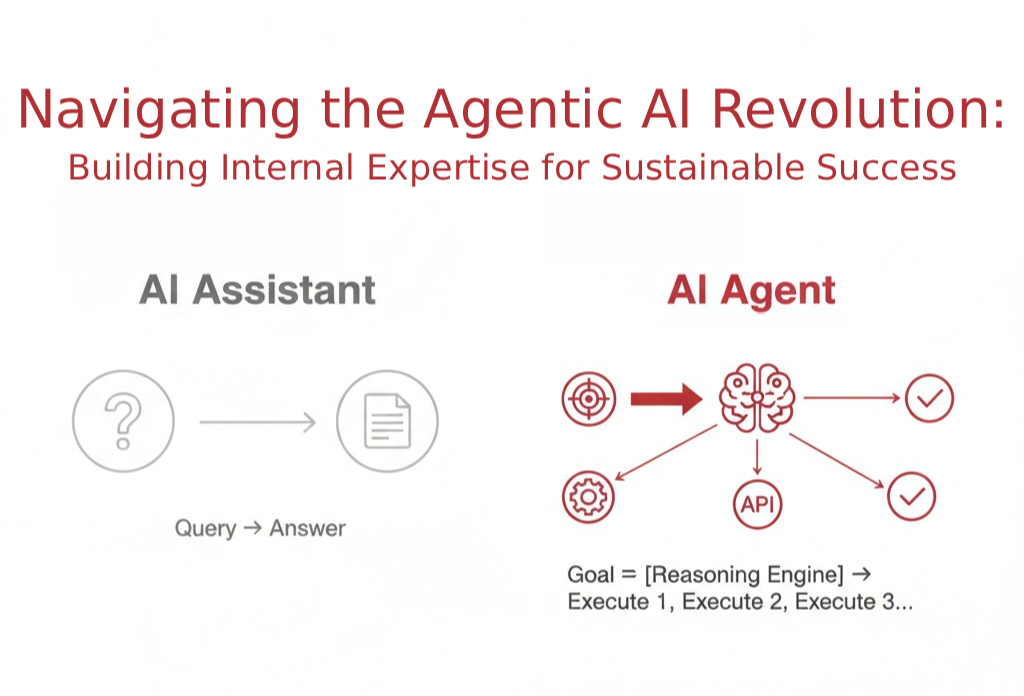
The market is at a major inflection point. The shift from artificial intelligence as a reactive assistant to an autonomous agent is no longer a future prediction, it’s happening now, fueled by rapid advancements from tech giants like IBM, Vercel, Microsoft, and Salesforce. This isn’t a niche movement; it's a fundamental architectural shift toward autonomy that will reshape how businesses operate. Agentic AI represents a move beyond simply augmenting human tasks to systems that can plan, reason, and execute complex workflows with minimal human intervention. This evolution from a “question-answer” model to a “goal-execute” model holds immense promise, with Boston Consulting Group estimating potential acceleration of core business processes by 30-50% and reductions in low-value work by up to 40%.
However, a critical warning sign is flashing. Despite the excitement and investment, nearly 80% of companies using generative AI haven't seen significant bottom-line impact. This “GenAI Paradox”, widespread adoption with elusive value, isn't a temporary hiccup. It’s a symptom of deeper foundational weaknesses. This moment is best understood as AI entering Gartner’s “Trough of Disillusionment,” where early enthusiasm wanes as the technology fails to meet expectations. The problem isn’t the technology itself, but rather an organization’s readiness to implement it effectively.
The Capability-Governance Gap: A Dangerous Disconnect
The root cause of this paradox is a "Capability-Governance Gap", a significant mismatch between the power of AI tools and an organization’s ability to manage them strategically. Organizations are facing a stark reality: access to powerful AI doesn’t guarantee successful implementation. The sources of this gap are multi-faceted, including piecemeal AI deployments focused on generic tools, poor data quality, a lack of C-suite leadership, and the tendency to “bolt AI onto broken processes.” The statistic that 85% of AI projects fail due to poor data quality is particularly sobering, underscoring the critical importance of a robust data infrastructure.
Addressing these gaps requires a fundamental shift in how organizations approach AI. It’s not simply about adopting the latest tools; it’s about building internal capability and establishing clear governance frameworks. Many organizations are approaching AI as a series of disconnected tactical deployments, focusing on “horizontal” tools like chatbots, while neglecting high-impact “vertical” solutions that target specific business problems. Successfully navigating this landscape requires a proactive strategy, a dedicated team, and a clear understanding of where AI can deliver the greatest value.
This is where Red Mt AI differentiates itself. We don’t just deploy AI solutions for our clients; we empower them to build, maintain, and innovate with AI themselves. At Red Mt AI, we offer an AI Readiness Assessment & Strategy Development service designed to directly address the Capability-Governance Gap. This assessment doesn’t just identify your weaknesses; it lays the groundwork for a tailored roadmap, ensuring your AI integration aligns with your specific business goals.
From Risk to Reward: Preparing for Agentic AI
The stakes are significantly higher with the rise of agentic AI. While current GenAI assistants require human oversight, autonomous agents will execute decisions automatically, at machine speed and scale. This amplifies existing vulnerabilities, potentially turning a financial disappointment into a source of catastrophic operational, financial, and reputational risk. Potential failures include chained vulnerabilities, cross-agent task escalation, and untraceable data leakage.
The key to navigating this new landscape isn’t simply having AI, but understanding it. This requires strategic C-suite ownership, deep internal expertise, and robust data governance. Moving beyond simply achieving “AI literacy” for employees to cultivating “AI fluency” in the C-suite – the ability to strategically think with a new paradigm – is crucial. The most valuable AI capability an enterprise can build isn't a proprietary model, but a "governance-enabled" data architecture. This means prioritizing data quality, integration, and establishing a single source of truth.
Successfully integrating AI isn't about having the best technology; it’s about having the systems and processes in place to use it responsibly and effectively – and, crucially, the internal knowledge to sustain that success. That’s why Red Mt AI focuses on knowledge transfer and ongoing support, enabling your team to become self-sufficient in the long run. This sustainable approach reduces reliance on external vendors and ensures you can continuously adapt and innovate with AI.
The transition to agentic AI demands a deliberate and strategic approach. The organizations that proactively build the foundational capabilities of strategic ownership, deep expertise, and robust data governance will be the ones that thrive in the coming years.
Ready to bridge the Capability-Governance Gap and unlock the full potential of Agentic AI? Reach out to us!
